
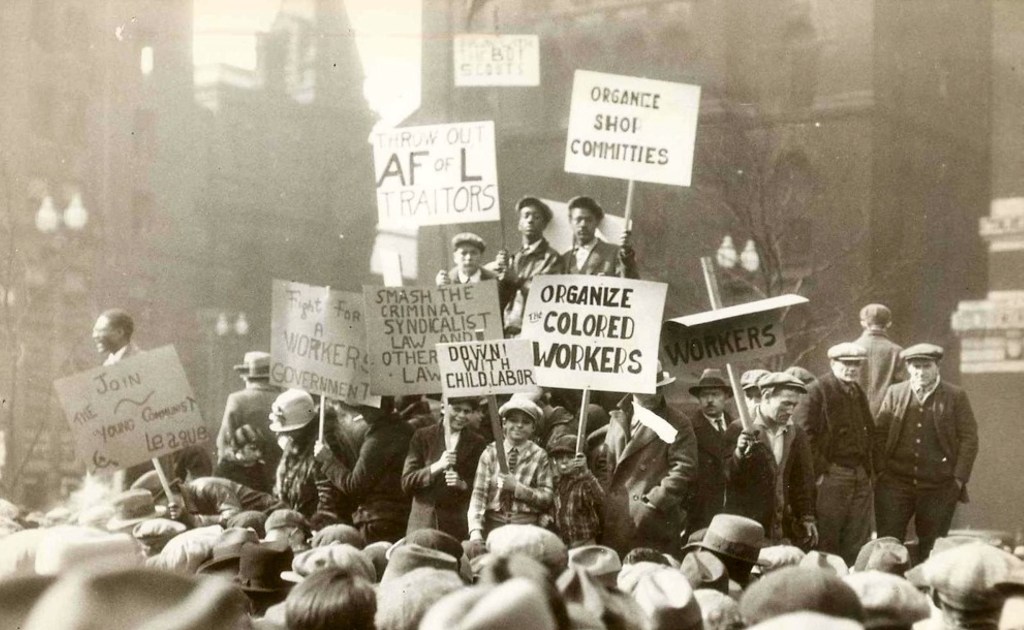


I. THE 1928 COMINTERN RESOLUTION ON THE NEGRO QUESTION IN THE UNITED STATES.
1. The industrialization of the South, the concentration of a new Negro working class population in the big cities of the East and North, and the entrance of the Negroes into the basic industries on a mass scale, create the possibility for the Negro workers, under the leadership of the Communist Party, to assume the hegemony of all Negro liberation movements, and to increase their importance and role in the revolutionary struggle of the American proletariat.
The Negro working class has reached a stage of development which enables it, if properly organized and well led, to fulfill successfully its double historical mission:
(a) To play a considerable role in the class struggle against American imperialism as an important part of the American working class; and
(b) To lead the movement of the oppressed masses of the Negro population.
2. The bulk of the Negro population (86%) live in the Southern states; of this number, 74 per cent live in the rural districts and are dependent almost exclusively upon agriculture for a livelihood. Approximately one-half of these rural dwellers live in the so-called “Black Belt,” in which area they constitute more than 50 per cent of the entire population. The great mass of the Negro agrarian population is subject to the most ruthless exploitation and persecution of a semi-slave character. In addition to the ordinary forms of capitalist exploitation, American imperialism utilizes every possible form of slave exploitation (peonage, sharecropping, landlord supervision of crops and marketing, etc.) for the purpose of extracting super-profits. On the basis of these slave remnants, there has grown up a super-structure of social and political inequality that expresses itself in lynching, segregation, Jim Crowism, etc.
Necessary Conditions for National Revolutionary Movement.
3. The various forms of oppression of the Negro masses, who are concentrated mainly in the so-called “Black Belt,” provide the necessary conditions for a national revolutionary movement among the Negroes. The Negro agricultural laborers and the tenant farmers feel most the pressure of white persecution and exploitation. Thus, the agrarian problem lies at the root of the Negro national movement. The great majority of Negroes in the rural districts of the South are not “reserves of capitalist reaction,” but potential allies of the revolutionary proletariat. Their objective position facilitates their transformation into a revolutionary force, which, under the leadership of the proletariat, will be able to participate in the joint struggle with all other workers against capitalist exploitation.
4. It is the duty of the Negro workers to organize through the mobilization of the broad masses of the Negro population the struggle of the agricultural laborers and tenant farmers against all forms of semi-feudal oppression. On the other hand, it is the duty of the Communist Party of the U.S.A. to mobilize and rally the broad masses of the white workers for active participation in this struggle. For that reason the Party must consider the beginning of systematic work in the South as one of its main tasks, having regard for the fact that the bringing together of the workers and toiling masses of all nationalities for a joint struggle against the landowners and the bourgeoisie is one of the most important aims of the Communist International, as laid down in the resolutions on the national and colonial question of the Second and Sixth Congresses of the Comintern.
For Complete Emancipation of Oppressed Negro Race.
5. To accomplish this task, the Communist Party must come out as the champion of the right of the oppressed Negro race for full emancipation. While continuing and intensifying the struggle under the slogan of full social and political equality for the Negroes, which must remain the central slogan of our Party for work among the masses, the Party must come out openly and unreservedly for the right of the Negroes to national self-determination in the Southern states, where the Negroes form a majority of the population. The struggle for equal rights and the propaganda for the slogan of self-determination must be linked up with the economic demands of the Negro masses, especially those directed against the slave remnants and all forms of national and racial oppression. Special stress must be laid upon organizing active resistance against lynching, Jim Crowism, segregation and all other forms of oppression of the Negro population.
6. All work among the Negroes, as well as the struggle for the Negro cause among the whites, must be used, based upon the changes which have taken place in the relationship of classes among the Negro population. The existence of a Negro industrial proletariat of almost two million workers makes it imperative that the main emphasis should be placed on these new proletarian forces. The Negro workers must be organized under the leadership of the Communist Party and thrown into joint struggle together with the white workers. The Party must learn to combine all demands of the Negroes with the economic and political struggle of the workers and the poor farmers.
American Negro Question Part of World Problem.
7. The Negro question in the United States must be treated in its relation to the Negro questions and struggles in other parts of the world. The Negro race everywhere is an oppressed race. Whether it is a minority (U.S.A., etc.), majority (South Africa) or inhabits a so-called independent state (Liberia, etc.), the Negroes are oppressed by imperialism. Thus, a common tie of interest is established for the revolutionary struggle of race and national liberation from imperialist domination of the Negroes in various parts of the world. A strong Negro revolutionary movement in the U.S.A. will be able to influence and direct the revolutionary movement in all those parts of the world where the Negroes are oppressed by imperialism.
8. The proletarianization of the Negro masses makes the trade unions the principal form of mass organization. It is the primary task of the Party to play an active part and lead in the work of organizing the Negro workers and agricultural laborers in trade unions. Owing to the refusal of the majority of the white unions in the U.S.A., led by the reactionary leaders, to admit Negroes to membership, steps must be immediately taken to set up special unions for those Negro workers who are not allowed to join the white unions. At the same time, however, the struggles for the inclusion of Negro workers in the existing unions must be intensified and concentrated upon. Special attention must be given to those unions in which the statutes and rules set up special limitations against the admission of Negro workers. The primary duty of Communist Party in this connection is to wage a merciless struggle against the A. F. of L. bureaucracy, which prevents the Negro workers from joining the white workers’ unions. The organization of special trade unions for the Negro masses must be carried out as part and parcel of the struggle against the restrictions imposed upon the Negro workers and for their admission to the white workers’ unions. The creation of separate Negro unions should in no way weaken the struggle in the old unions for the admission of Negroes on equal terms. Every effort must be made to see that all the new unions organized by the Left wing and by the Communist Party should embrace the workers of all nationalities and of all races. The principle of one union for all workers in each industry, white and Black, should cease to be a mere slogan of propaganda, and must become a slogan of action.
Party Trade Union Work Among Negroes.
9. While organizing the Negroes into unions and conducting an aggressive struggle against the anti-Negro trade union policy of the A. F. of L., the Party must pay more attention than it has hitherto done to the work in the Negro workers’ organizations, such as the Brotherhood of Sleeping Car Porters, Chicago Asphalt Workers’ Union, and so on. The existence of two million Negro workers and the further industrialization of the Negroes demands a radical change in the work of the Party among the Negroes. The creation of working-class organizations and the extension of our influence in the existing working class Negro organizations are of much greater importance than the work in bourgeois and petty-bourgeois organizations, such as the National Association for the Advancement of Colored People, the Pan-African Congress, etc.
10. The American Negro Labor Congress continues to exist only nominally. Every effort should be made to strengthen this organization as a medium through which we can extend the work of the Party among the Negro masses and mobilize the Negro workers under our leadership. After careful preparatory work, which must be started at once, another convention of the American Negro Labor Congress should be held. A concrete plan must also be presented to the Congress for an intensified struggle for the economic, social, political and national demands of the Negro masses. The program of the American Negro Labor Congress must deal specially with the agrarian demands of the Negro farmers and tenants in the south.
11. The importance of trade union work imposes special tasks upon the Trade Union Educational League, The T.U.E.L. has completely neglected the work among the Negro workers, notwithstanding the fact that these workers are objectively in a position to play a very great part in carrying through the program of organizing the unorganized. The closest contact must be established between the T.U.E.L. and the Negro masses. The T.U.E.L. must become the champion in the struggle for the rights of the Negroes in the old unions, and in the organizing of new unions for both Negroes and whites, as well as separate Negro unions.
White Chauvinism Evidenced in the American Party.
The C.E.C. of the American Communist Party itself stated in its resolution of April 30, 1928, that “the Party as a whole has not sufficiently realized the significance of work among the Negroes.” Such an attitude toward the Party work among the Negroes is, however, not satisfactory. The time is ripe to begin within the Party a courageous campaign of self-criticism concerning the work among the Negroes. Penetrating self-criticism is the necessary preliminary condition for directing the Negro work along new lines.
13. The Party must bear in mind that white chauvinism, which is the expression of the ideological influence of American imperialism among the workers, not only prevails among different strata of the white workers in the U.S.A., but is even reflected in various forms in the Party itself. White chauvinism has manifested itself even in open antagonism of some comrades to the Negro comrades. In some instances where Communists were called upon to champion and to lead in the most vigorous manner the fight against white chauvinism, they instead yielded to it. In Gary, white members of the Workers Party protested against Negroes eating in the restaurant controlled by the Party. In Detroit, Party members, yielding to pressure, drove out Negro comrades from a social given in aid of the miners on strike.
Whilst the Party has taken certain measures against these manifestations of white chauvinism, nevertheless those manifestations must be regarded as indications of race prejudice even in the ranks of the Party, which must be fought with the utmost energy.
14. An aggressive fight against all forms of white chauvinism must be accompanied by a widespread and thorough educational campaign in the spirit of internationalism within the Party, utilizing for this purpose to the fullest possible extent the Party schools, the Party press and the public platform, to stamp out all forms of antagonism, or even indifference among our white comrades toward the Negro work. This educational work should be conducted simultaneously with a campaign to draw the white workers and the poor farmers into the struggle for the support of the demands of the Negro workers.
Tasks of Party in Relation to Negro Work.
15. The Communist Party of the U.S.A., in its treatment of the Negro question, must all the time bear in mind this twofold task:
(a) To fight for the full rights of the oppressed Negroes and for their right to self-determination and against all forms of chauvinism, especially among the workers of the oppressing nationality.
(b) The propaganda and the day-to-day practice of international class solidarity must be considered as one of the basic tasks of the American Communist Party. The fight — by propaganda and by deeds — should be directed first and foremost against the chauvinism of the workers of the oppressing nationality as well as against bourgeois segregation tendencies of the oppressed nationality. The propaganda of international class solidarity is the necessary prerequisite for the unity of the working class in the struggle.
“The center of gravity in educating the workers of the oppressing countries in the principles of internationalism must inevitably consist in the propaganda and defense by these workers of the right of segregation by the oppressed countries. We have the right and duty to treat every socialist of an oppressing nation, who does not conduct such propaganda, as an imperialist and as a scoundrel.” (Lenin, selected articles on the national question.)
16. The Party must seriously take up the task of training a cadre of Negro comrades as leaders, bring them into the Party schools in the U.S.A. and abroad, and make every effort to draw Negro proletarians into active and leading work in the Party, not confining the activities of the Negro comrades exclusively to the work among Negroes. Simultaneously, white workers must specially be trained for work among the Negroes.
17. Efforts must be made to transform the “Negro Champion” into a weekly mass organ of the Negro proletariat and tenant farmers. Every encouragement and inducement must be given to the Negro comrades to utilize the Party press generally.
Negro Work Part of General Work of Party.
18. The Party must link up the struggle on behalf of the Negroes with the general campaigns of the Party. The Negro problem must be part and parcel of all, and every campaign conducted by the Party. In the election campaigns, trade union work, the campaigns for the organization of the unorganized, anti-imperialist work, labor party campaign, International Labor Defense, etc.,[] the Central Executive Committee must work out plans designed to draw the Negroes into active participation in all these campaigns, and at the same time to bring the white workers into the struggle on behalf of the Negroes’ demands. It must be borne in mind that the Negro masses will not be won for the revolutionary struggles until such time as the most conscious section of the white workers show, by action, that they are fighting with the Negroes against all racial discrimination and persecution. Every member of the Party must bear in mind that “the age-long oppression of the colonial and weak nationalities by the imperialist powers has given rise to a feeling of bitterness among the masses of the enslaved countries as well as a feeling of distrust toward the oppressing nations, in general, and toward the proletariat of those nations.” (See resolution on Colonial and National Question of Second Congress.)
19. The Negro women in industry and on the farms constitute a powerful potential force in the struggle for Negro emancipation. By reason of being unorganized to an even greater extent than male Negro workers, they are the most exploited section. The A. F. of L. bureaucracy naturally exercises toward them a double hostility, by reason of both their color and sex. It therefore becomes an important task of the Party to bring the Negro women into the economic and political struggle.
20. Only by an active and strenuous fight on the part of the white workers against all forms of oppression directed against the Negroes will the Party be able to draw into its ranks the most active and conscious Negro workers — men and women — and to increase its influence in those intermediary organizations which are necessary for the mobilization of the Negro masses in the struggle against segregation, lynching, Jim Crowism, etc.
21. In the present struggle in the mining industry, the Negro workers participate actively and in large numbers. The leading role the Party played in this struggle has helped greatly to increase its prestige. Nevertheless, the special efforts being made by the Party in the work among the Negro strikers cannot be considered as adequate. The Party did not send enough Negro organizers into the coalfields, and it did not sufficiently attempt, in the first stages of the fight, to develop the most able Negro strikers and to place them in leading positions. The Party must be especially criticized for its failure to put Negro workers on the Presidium of the Pittsburgh Miners’ Conference, doing so only after such representation was demanded by the Negroes themselves.
22. In the work among the Negroes, special attention should be paid to the role played by the churches and preachers who are acting on behalf of American imperialism. The Party must conduct a continuous and carefully worked out campaign among the Negro masses, sharpened primarily against the preachers and the churchmen, who are the agents of the oppressors of the Negro race.
Party Work Among Negro Proletariat and Peasantry.
23. The Party must apply united front tactics for specific demands to the existing Negro petty bourgeois organizations. The purpose of these united front tactics should be the mobilizing of the Negro masses under the leadership of the Party, and to expose the treacherous petty bourgeois leadership of those organizations.
24. The Negro Miners Relief Committee and the Harlem Tenants League are examples of joint organizations of action which may serve as a means of drawing the Negro masses into struggle. In every case the utmost effort must be made to combine the struggle of the Negro workers with the struggle of the white workers, and to draw the white workers’ organizations into such joint campaigns.
25. In order to reach the bulk of the Negro masses, special attention should be paid to the work among the Negroes in the South. For that purpose, the Party should establish a district organization in the most suitable locality in the South. Whilst continuing trade union work among the Negro workers and the agricultural laborers, special organizations of tenant farmers must be set up. Special efforts must also be made to secure the support of the sharecroppers in the creation of such organizations. The Party must undertake the task of working out a definite program of immediate demands, directed against all slave remnants, which will serve as the rallying slogans for the formation of such peasant organizations.
Henceforth the Workers (Communist) Party must consider the struggle on behalf of the Negro masses, the task of organizing the Negro workers and peasants, and the drawing of these oppressed masses into the proletarian revolutionary struggle as one of its major tasks, remembering, in the words of the Second Congress resolution, that “the victory over capitalism cannot be fully achieved and carried to its ultimate goal unless the proletariat and the toiling masses of all nations of the world rally of their own accord in a concordant and close union. (Political Secretariat, Communist International, Moscow, U.S.S.R., Oct. 26, 1928.)
II. THE 1930 COMINTERN RESOLUTION ON THE NEGRO QUESTION IN THE UNITED STATES
The C.P. of the United States has always acted openly and energetically against negro oppression and has thereby won increasing sympathy among the Negro population. In its own ranks, too, the Party has relentlessly fought the slightest evidences of white chauvinism and has purged itself of the gross opportunism of the Lovestoneites. According to the assertions of these people, the “industrial revolution” will sweep away the remnants of slavery in the agricultural South, and will proletarianize the Negro peasantry, so that the Negro question, as a special national question, would thereby be presumably solved; or could be put off until the time of the socialist revolution in America. But the Party has not yet succeeded in overcoming in its own ranks all under-estimation of the struggle for the slogan of the right of self-determination, and still less succeeded in doing away with all lack of clarity on the Negro question. In the Party discussion, the question was often wrongly put and much erroneous counterpoising of phases of the question occurred; thus, for instance, should the slogan of social equality or the slogan of the right of self-determination of the Negroes be emphasized? Should only propaganda for the Negroes’ right to self-determination be carried on, or should this slogan be considered as a slogan of action? Should separatist tendencies among the Negroes be supported or opposed? is the Southern region, thickly populated by Negroes, to be looked upon as a colony, or as an “integral part of the national economy of the United States,” where presumably a revolutionary situation cannot arise independent of the general revolutionary development in the United States?
In the interest of the utmost clarity of ideas on this question, the Negro question in the United States must be viewed from the standpoint of its peculiarity, namely as the question of an oppressed nation, which is in a peculiar and extraordinarily distressing situation of national oppression, not only in view of the prominent racial distinctions (marked difference in the color of skin, etc.), but above all because of considerable social antagonism (remnants of slavery). This introduces into the American Negro question an important, peculiar trait which is absent from the national question of other oppressed peoples. Furthermore, it is necessary to face clearly the inevitable distinction between the position of the Negro in the South and in the North, owing to the fact that at least three-fourths of the entire Negro population of the United States (12 million) live in compact masses in the South; most of them being peasants and agricultural laborers in a state of semi-serfdom, settled in the “Black Belt” and constituting the majority of the population, whereas the Negroes in the Northern States are for the most part industrial workers of the lowest categories who have recently come to the various industrial centers from the South (having often even fled from there).
The struggle of the Communists for the equal rights of the Negroes applies to all Negroes, in the North as well as in the South. The struggle for this slogan embraces all, or almost all of the important special interests of the Negroes in the North, but not in the South, where the main Communist slogan must be: The right of self-determination of the Negroes in the Black Belt. These two slogans, however, are most closely connected. The Negroes in the North are very much interested in winning the right of self-determination for the Negro population of the Black Belt and can thereby hope for strong support for the establishment of true equality of the Negroes in the North. In the South the Negroes are suffering no less but still more than in the North from the glaring lack of all equality; for the most part, the struggle for their most urgent partial demands in the Black Belt is nothing more than the struggle for their equal rights, and only the fulfilment of their main slogan, the right of self-determination in the Black Belt, can assure them of true equality.
I. The Struggle for the Equal Rights of the Negroes.
2. The basis for the demand of equality of the Negroes is provided by the special yoke to which the Negroes in the United States are subjected by the ruling classes. In comparison with the situation of the other various nationalities and faces oppressed by American imperialism, the yoke of the Negroes in the United States is of a peculiar nature and particularly oppressive. This is partly due to the historical past of the American Negroes as imported slaves, but is much more due to the still existing slavery of the American Negro which is immediately apparent, for example, in comparing their situation even with the situation of the Chinese and Japanese workers in the West of the United States, or with the lot of the Filipinos who are under colonial repression.
It is only a Yankee bourgeois lie to say that the yoke of Negro slavery has been lifted in the United States. Formally, it has been abolished; but in practice, the great majority of the Negro masses in the South are living in slavery in the literal sense of the word. Formally, they are “free” as “tenant farmers” or “contract laborers” on the big plantations of the white landowners, but actually, they are completely in the power of their exploiters. They are not permitted, or else it is made impossible for them to leave their exploiters; if they do leave the plantations, they are brought back and, in many cases, whipped. Many of them are simply taken prisoner under various pretexts, and bound together with long chains, they have to do compulsory labor on the roads. All through the South, the Negroes are not only deprived of all rights and subjected to the arbitrary will of the white exploiters, but they are also socially ostracized; that is, they are treated in general not as human beings, but as cattle. But this ostracism regarding Negroes is not limited to the South. Not only in the South, but throughout the United States, the lynching of Negroes is permitted to go unpunished. Everywhere, the American bourgeoisie surrounds the Negroes with an atmosphere of social ostracism.
The 100 per cent Yankee arrogance divides the American population into a series of castes, among which the Negroes constitute, so to speak, the caste of the “untouchables,” who are in a still lower category than the lowest categories of human society, the immigrant laborers, the yellow immigrants and the Indians. In all big cities the Negroes have to live in special segregated ghettoes (and, of course, have to pay extremely high rent). In practice, marriage between Negroes and whites is prohibited, and in the South, this is even forbidden by law. In various other ways, the Negroes are segregated, and if they overstep the bounds of the segregation, they immediately run the risk of being ill-treated by the 100 percent bandits. As wage-earners, the Negroes are forced to perform the lowest and most difficult work; they generally receive lower wages than the white workers and don’t always get the same wages as white workers doing similar work; and their treatment is the very worst. Many A. F. of L. trade unions do not admit Negro workers in their ranks, and a number have organized special trade unions for Negroes so that they will not have to let them into their “good white society.”
This whole system of “segregation” and “Jim Crowism” is a special form of national and social oppression under which the American Negroes have much to suffer. The origin of all this is not difficult to find: this Yankee arrogance towards the Negroes stinks of the disgusting atmosphere of the old slave market. This is downright robbery and slave-whipping barbarism at the peak of capitalist “culture.”
3. The demand for equal rights in our sense of the word means not only demanding the same rights for the Negroes as the whites have in the United States at the present time but also demanding that the Negroes should be granted all rights and other advantages which we demand for the corresponding oppressed classes of whites (workers and other toilers). Thus, in our sense of the word, the demand for equal rights means a continuous work of abolishment of all forms of economic and political oppression of the Negroes; as well as 1heir social exclusion, the insults perpetrated against them and their segregation. This is to be obtained by constant struggle by the white and Black workers for effective legal protection for the Negroes in all fields, as well as actual enforcement of their equality and combating of every expression of Negrophobia. One of the first Communist slogans is: Death for Negro lynching!
The struggle for the equal rights of the Negroes does not in any way exclude recognition and support for the Negroes’ rights to their own special schools, government organs, etc., wherever the Negro masses put forward such national demands of their own accord. This will, however, in all probability occur to any great extent only in the Black Belt. In other parts of the country, the Negroes suffer above all from being shut out from the general social institutions and not from being prohibited to set up their own national institutions. With the development of the Negro intellectuals (principally in the “free” professions) and of a thin layer of small capitalist business-people, there have appeared lately, not only definite efforts for developing a purely national Negro culture but also outspoken bourgeois tendencies towards Negro nationalism. The broad masses of the Negro population in the big industrial centers of the North are, however, making no efforts whatsoever to maintain and cultivate a national aloofness; they are, on the contrary, working for assimilation. This effort of the Negro masses can do much in the future to facilitate the progressive process of amalgamating the whites and Negroes into one nation, and it is under no circumstances the task of the Communists to give support to bourgeois nationalism in its fight with the progressive assimilation tendencies of the Negro working masses.
4. The slogan of equal rights of the Negroes without a relentless struggle in practice against all manifestations of Negrophobia on the part of the American bourgeoisie can be nothing but a deceptive liberal gesture of a sly slave-owner or his agent. This slogan is in fact repeated by “socialist” and many other bourgeois politicians and philanthropists who want to get publicity for themselves by appealing to the “sense of justice” of the American bourgeoisie in the individual treatment of the Negroes, and thereby side-track attention from the one effective struggle against the shameful system of “white superiority”: from the class struggle against the American bourgeoisie. The struggle for equal rights for the Negroes is in fact, one of the most important parts of the proletarian class struggle of the United States.
The struggle for the equal rights for the Negroes must certainly take the form of common struggle by the white and black workers.
The increasing unity of the various working-class elements provokes constant attempts on the part of the American bourgeoisie to play one group against another, particularly the white workers against the Black and the Black workers against the immigrant workers and vice versa; and thus, to promote divisions within the working class, which contributes to the bolstering up of American capitalist rule. The Party must carry on a ruthless struggle against all these attempts of the bourgeoisie and do everything to strengthen the bonds of class solidarity of the working-class upon a lasting basis.
In the struggle for equal rights for the Negroes, however, it is the duty of the white workers to march at the head on this struggle. They must everywhere make a breach in the walls of segregation and “Jim Crowism” which have been set up by bourgeois slave-market morality. They must most ruthlessly unmask and condemn the hypocritical reformists and bourgeois “friends of Negroes” who, in reality, are only interested in strengthening the power of the enemies of the Negroes. They, the white workers, must boldly jump at the throat of the 100 percent bandits who strike a Negro in the face. This struggle will be the test of the real international solidarity of the American white workers.
It is the special duty of the revolutionary Negro workers to carry on tireless activity among the Negro working masses to free them of their distrust of the white proletariat and draw them into the common front of the revolutionary class struggle against the bourgeoisie. They must emphasize with all force that the first rule of proletarian morality is that no worker who wants to be an equal member of his class must ever serve as a strike-breaker or a supporter of bourgeois politics. They must ruthlessly unmask all Negro politicians corrupted or directly bribed by American bourgeois ideology, who systematically interfere with the real proletarian struggle for the equal rights for the Negroes.
Furthermore, the Communist Party must resist all tendencies within its own ranks to ignore the Negro question as a national question in the United States, not only in the South, but also in the North. It is advisable for the Communist Party in the North to abstain from the establishment of any special Negro organizations, and in place of this to bring the black and white workers together in common organizations of struggle and joint action. Effective steps must be taken for the organization of Negro workers in the T.U.U.L. and revolutionary trade unions. Under-estimation of this work takes various forms: lack of energy in recruiting Negro workers, in keeping them in our ranks and in drawing them into the full life of the trade unions, in selecting, educating and promoting Negro forces to leading functions in the organization. The Party must make itself entirely responsible for the carrying through of this very important work. It is most urgently necessary to publish a popular mass paper dealing with the Negro question, edited by white and Black comrades, and to have all active followers of this paper grouped organizationally.
2. The Struggle for the Right of Self-determination of the Negroes in the Black Belt.
5. It is not correct to consider the Negro zone of the South as a colony of the United States. Such a characterization of the Black Belt could be based in some respects only upon artificially construed analogies, and would create superfluous difficulties for the clarification of ideas. In rejecting this estimation, however, it should not be overlooked that it would be nonetheless false to try to make a fundamental distinction between the character of national oppression to which the colonial peoples are subjected, and the yoke of other oppressed nations. Fundamentally, national oppression in both cases is of the same character; and is in the Black Belt, in many respects worse than in a number of actual colonies. On the one hand the Black Belt is not in itself, either economically or politically, such a united whole as to warrant its being called a special colony of the United States, but on the other hand this zone is not, either economically or politically, such an integral part of the whole United States as any other part of the country. Industrialization in the Black Belt is not, as is generally the case in colonies properly speaking, in contradiction with the ruling interests of the imperialist bourgeoisie, which has in its hands the monopoly of the entire industry; but insofar as industry is developed here, it will in no way bring a solution to the question of living conditions of the oppressed Negro majority, or to the agrarian question, which lies at the basis of the national question. On the contrary, this question is still further aggravated as a result of the increase of the contradictions arising from the pre-capitalist forms of exploitation of the Negro peasantry and of a considerable portion of the Negro proletariat (miners, forestry workers, etc.) in the Black Belt, and at the same time owing to the industrial development here, the growth of the most important driving force of the national revolution, the Black working-class, is especially strengthened. Thus, the prospect for the future is not an inevitable dying away of the national revolutionary Negro movement in the South, as Lovestone prophesied; but, on the contrary, a great advance of this movement and the rapid approach of a revolutionary crisis in the Black Belt.
6. Owing to the peculiar situation in the Black Belt (the fact that the majority of the resident Negro population are farmers and agricultural laborers and that the capitalist economic system as well as political class rule there is not only of a special kind, but to a great extent still has pre-capitalist and semi-colonial features), the right of self-determination of the Negroes as the main slogan of the Communist Party in the Black Belt is appropriate. This, however, does not in any way mean that the struggle for equal rights of the Negroes in the Black Belt is less necessary or less well founded than it is in the North. On the contrary, here, owing to the whole situation, this struggle is even better founded, but the form of this slogan does not sufficiently correspond with the concrete requirements of the liberation struggle of the Negro population. Anyway, it is clear that in most cases it is a question of the daily conflicts of interest between the Negroes and the white rulers in the Black Belt on the subject of infringement of the most elementary equality rights of the Negroes by the whites. Daily events of the kind are: all Negro persecutions, all arbitrary economic acts of robbery by the white exploiters (“Black Man’s Burden”) and the whole system of so-called “Jim Crowism.” Here, however, it is very important in connection with all these concrete cases of conflict to concentrate the attention of the Negro masses not so much to the general demands of mere equality, but much more to some of the revolutionary basic demands arising from the concrete situation.
The slogan of the right of self-determination occupies the central place in the liberation struggle of the Negro population in the Black Belt against the yoke of American imperialism, but this slogan, as we see it, must be carried out only in connection with two other basic demands. Thus, there are three basic demands to be kept in mind in the Black Belt; namely, the following:
(1) Confiscation of the landed property of the white landowners and capitalists for the benefit of the Negro farmers. The landed property in the hands of the white American exploiters constitutes the most important material basis of the entire system of national oppression and serfdom of the Negroes in the Black Belt. More than three-quarters of all Negro farmers here are bound in actual serfdom to the farms and plantations of the white exploiters by the feudal system of “share cropping.” Only on paper and not in practice are they freed from the yoke of their former slavery. The same holds completely true for the great mass of black contract laborers; here the contract is only the capitalist expression of the chains of the old slavery, which even today are not infrequently applied in their natural iron form on the roads of the Black Belt (chain-gang work). These are the main forms of present Negro slavery in the Black Belt and no breaking of the chains of this slavery is possible without confiscating all the landed property of the white masters. Without this revolutionary measure, without the agrarian revolution, the right of self-determination of the Negro population would be only a Utopia; or, at best, would remain only on paper without changing in any way the actual enslavement.
(2) Establishment of the State Unity of the Black Belt. At the present time this Negro zone — precisely for the purpose of facilitating national oppression — is artificially split up and divided into a number of various states which include distant localities having a majority-white population. If the right of self-determination of the Negroes is to be put into force, it is necessary wherever possible to bring together into one governmental unit all districts of the South where the majority of the settled population consists of Negroes. Within the limits of this state there will of course remain a fairly significant white minority which must submit to the right of self-determination of the Negro majority. There is no other possible way of carrying out in a democratic manner the right of self-determination of the Negroes. Every plan regarding the establishment of the Negro State with an exclusively Negro population in America (and, of course, still more exporting it to Africa) is nothing but an unreal and reactionary caricature of the fulfilment of the right of self-determination of the Negroes and every attempt to isolate and transport the Negroes would have the most damaging effect upon their interests; above all, it would violate the right of the Negro farmers in the Black Belt not only to their present residences and their land but also to the land owned by the white landlords and cultivated by Negro labor.
(3) Right of Self-Determination. This means complete and unlimited right of the Negro majority to exercise governmental authority in the entire territory of the Black Belt, as well as to decide upon the relations between their territory and other nations, particularly the United States. It would not be right of self-determination in our sense of the word if the Negroes in the Black Belt had the right of determination only in cases which concerned exclusively the Negroes and did not affect the whites, because the most important cases arising here are bound to affect the Negroes as well as the whites. First of all, true right to self-determination means that the Negro majority and not the white minority in the entire territory of the administratively united Black Belt exercises the right of administrating governmental, legislative and judicial authority. At the present time, all this power here is concentrated in the hands of the white bourgeoisie and landlords. It is they who appoint all officials; it is they who dispose of public property, it is they who determine the taxes, it is they who govern and make the laws. Therefore, the overthrow of this class rule in the Black Belt is unconditionally necessary in the struggle for the Negroes’ right to self-determination. This however means, at the same time, the overthrow of the yoke of American imperialism in the Black Belt on which the forces of the local white bourgeoisie depend. Only in this way, only if the Negro population of the Black Belt wins its freedom from American imperialism even to the point of deciding itself the relations between its country and other governments, especially the United States, will it win real and complete self-determination. One should demand from the beginning that no armed forces of American imperialism should remain on the territory of the Black Belt.
7. As stated in the letter of the Polit. Secretariat of the E.C.C.I. of March 16th, 1930, the Communists must “unreservedly carry on a struggle” for the self-determination of the Negro population in the Black Belt in accordance with what has been set forth above. It is incorrect and harmful to interpret the Communist standpoint to mean that the Communists stand for the right of self-determination of the Negroes only up to a certain point, but not beyond this, for example, to the right of separation. It is also incorrect to say that the Communists are so far only to carry on propaganda or agitation for the right of self-determination, but not to develop any activity to bring this about. No, it is of the utmost importance for the Communist Party to reject any such limitation of its struggle for this slogan. Even if the situation does not yet warrant the raising of the question of uprising, one should not limit oneself at present to propaganda for the demand: “right to self-determination;” but should organize mass-actions such as demonstrations, strikes, tax-boycott-movements, etc.
Moreover, the Party cannot make its stand for this slogan dependent upon any conditions, even the condition that the proletariat has the hegemony in the national revolutionary Negro movement or that the majority of the Negroes in the Black Belt adopt the Soviet form (as Pepper demanded), etc. It goes without saying that the Communists in the Black Belt will and must try to win over all working elements of the Negroes, that is, the majority of the population, to their side and to convince them not only that they must win the right of self-determination, but also that they must make use of this right in accordance with the Communist programme. But this cannot be made a condition for the stand of the Communists in favor of the right of self-determination of the Negro population; if, or so long as the majority of this population wishes to handle the situation in the Black Belt in a different manner from that which we Communists would like, its complete right to self-determination must be recognized. This right we must defend as a free democratic right.
8. In general, the C.P. of the United States has kept to this correct line recently in its struggle for the right of self-determination of the Negroes even though this line — in some cases — has been unclearly or erroneously expressed. In particular, some misunderstanding has arisen from the failure to make a clear distinction between the demand for “right of self-determination” and the demand for governmental separation, simply treating these two demands in the same way. However, these two demands are not identical. Complete right to self-determination includes also the right to governmental separation, but does not necessarily imply that the Negro population should make use of this right under all circumstances. That is, that it must actually separate or attempt to separate the Black Belt from the existing governmental federation with the United States. If it desires to separate it must be free to do so; but if it prefers to remain federated with the United States it must also be free to do that. This is the correct meaning of the idea of self-determination, and it must be recognized quite independently of whether the United States are still a capitalist state or if a proletarian dictatorship has already been established there.
It is, however, another matter if it is not a case of the right of the oppressed nation concerned to separate or to maintain governmental contact; but if the question is treated on its merits, whether it is to work for state separation, whether it is to struggle for this or not. This is another question, on which the stand of the Communists must vary according to the concrete conditions. If the proletariat has come into power in the United States, the Communist Negroes will not come out for but against separation of the Negro Republic federation with the United States. But the right of the Negroes to governmental separation will be unconditionally realized by the Communist Party. It will unconditionally give the Negro population of the Black Belt freedom of choice even on this question. Only when the proletariat has come into power in the United States the Communists will carry on propaganda among the working masses of the Negro population against separation, in order to convince them that it is much better and in the interest of the Negro nation for the Black Belt to be a free republic, where the Negro majority has complete right of self-determination, but remains governmentally federated with the great proletarian republic of the United States. The bourgeois counter-revolutionists, on the other hand, will then be interested in boosting the separation tendencies in the ranks of the various nationalities in order to utilize separatist nationalism as a barrier for the bourgeois counter-revolution against the consolidation of the proletarian dictatorship.
But the question at the present time is not this. As long as capitalism rules in the United States the Communists cannot come out against governmental separation of the Negro zone from the United States. They recognize that this separation from the imperialist United States would be preferable from the standpoint of the national interests of the Negro population, to their present oppressed state, and therefore, the Communists are ready at any time to offer all their support if only the working masses of the Negro population are ready to take up the struggle for governmental independence of the Black Belt. At the present time, however, the situation in the national struggle in the South is not such as to win mass support of the working Negroes for this separatist struggle, and it is not the task of the Communists to call upon them to separate without taking into consideration the existing situation and the desires of the Negro masses.
The situation in the Negro question of the United States, however, may undergo a radical change. It is even probable that the separatist efforts to obtain complete State independence of the Black Belt will gain ground among the Negro masses of the South in the near future. This is connected with the prospective sharpening of the national conflicts in the South, with the advance of the national revolutionary Negro movement and with the exceptionally brutal fascists aggressiveness of the white exploiters of the South, as well as with the support of this aggressiveness by the central government authority of the United States. In this sharpening of the situation in the South, Negro separatism will presumably increase, and the question of the independence of the Black Belt will become the question of the day. Then, the Communist Party must also face this question, and if the circumstances seem favorable, must stand up with all strength and courage for the struggle to win independence and for the establishment of a Negro republic in the Black Belt.
9. The general relation of Communists to separatist tendencies among the Negroes, described above, cannot mean that Communists associate themselves at present, or generally speaking, during capitalism, indiscriminately and without criticism with all the separatist currents of the various bourgeois or petty-bourgeois Negro groups. For there is not only a national revolutionary, but also a reactionary Negro separatism. For instance, that represented by Garvey: his Utopia of an isolated Negro State (regardless if in Africa or America, if it is supposed to consist of Negroes only) pursues the only political aim of diverting the Negro masses from the real liberation struggle against American imperialism.
It would be a mistake to imagine that the right of self-determination slogan is a truly revolutionary slogan only in connection with the demand for complete separation. The question of power is decided not only through the demand of separation, but just as much through the demand of the right to decide the separation question and self-determination in general. A direct question of power is also the demand of confiscation of the land of the white exploiters in the South, as well as the demand of the Negroes that the entire Black Belt be amalgamated into a state unit.
Hereby, every single fundamental demand of the liberation struggle of the Negroes in the Black Belt is such that — if once thoroughly understood by the Negro masses and adopted as their slogan — it will lead them into the struggle for the overthrow of the power of the ruling bourgeoisie, which is impossible without such revolutionary struggle. One cannot deny that it is just possible for the Negro population of the Black Belt to win the right to self-determination already during capitalism, but it is perfectly clear and indubitable that this is possible only through successful revolutionary struggle for power against the American bourgeoisie through wresting the Negroes’ right to self-determination from the American imperialism. Thus, the slogan of right to self-determination is a real slogan of national rebellion, which, to be considered as such, need not be supplemented by proclaiming struggle for the complete separation of the Negro zone; at least not at present. But it must be made perfectly clear to the Negro masses that the slogan “right to self-determination” includes the demand of full freedom for them to decide even the question of complete separation. “We demand freedom of separation, real right to self-determination” — wrote Lenin: “certainly not in order to ‘recommend’ separation, but on the contrary; in order to facilitate and accelerate the democratic rapprochement and unification of nations.” For the same purpose, Lenin’s Party, the C.P. of the Soviet Union, bestowed after its seizure of power on all the peoples hitherto oppressed by Russian Tsarism the full right to self-determination, including the right of complete separation, and achieved thereby its enormous successes with regard to the democratic rapprochement and voluntary unification of nations.
10. The slogan for the self-determination right and the other fundamental slogans of the Negro question in the Black Belt does not exclude but rather pre-supposes an energetic development of the struggle for concrete partial demands linked up with the daily needs and afflictions of wide masses of working Negroes. In order to avoid, in this connection, the danger of opportunist backslidings, Communists must above all remember this:
(a) The direct aims and partial demands around which a partial struggle develops are to be linked up in the course of the struggle with the revolutionary fundamental slogans brought up by the question of power, in a popular manner corresponding to the mood of the masses. (Confiscation of the big land holdings, establishment of governmental unity of the Black Belt, right of self-determination of the Negro population in the Black Belt.) Bourgeois-socialist tendencies to oppose such a revolutionary widening and deepening of the fighting demands must be fought.
(b) One should not venture to draw up a complete programme of some kind or a system of “positive” partial demands. Such programmes on the part of petty-bourgeois politicians should be exposed as attempts to divert the masses from the necessary hard struggles by fostering reformist and democratic illusions among them. Every positive partial demand which might crop up is to be considered from the viewpoint of whether it is in keeping with our revolutionary fundamental slogans, or whether it is of a reformist or reactionary tendency. Every kind of national oppression which arouses the indignation of the Negro masses can be used as a suitable point of departure for the development of partial struggles, during which the abolition of such oppression, as well as their prevention through revolutionary struggle against the ruling exploiting dictatorship must be demanded.
(c) Everything should be done to bring wide masses of Negroes into these partial struggles — this is important — and not to carry the various partial demands to such an ultra-radical point, that the mass of working Negroes are no longer able to recognize them as their own. Without a real mobilization of the mass-movements — in spite of the sabotage of the bourgeois reformist Negro politicians — even the best Communist partial demands get hung up. On the other hand, even some relatively insignificant acts of the Ku-Klux-Klan bandits in the Black Belt can become the occasion of important political movements, provided the Communists are able to organize the resistance of the indignant Negro masses. In such cases, mass movements of this kind can easily develop into real rebellion. This rests on the fact that — as Lenin said — “Every act of national oppression calls forth resistance on the part of the masses of the population, and the tendency of every act of resistance on the part of oppressed peoples is the national uprising.”
d) Communists must fight in the forefront of the national-liberation movement and must do their utmost for the progress of this mass movement and its revolutionization. Negro Communists must clearly dissociate themselves from all bourgeois currents in the Negro movement, must indefatigably oppose the spread of the influence of the bourgeois groups on the working Negroes, and in dealing with them must apply the Communist tactic laid down by the Sixth C.I. Congress with regard to the colonial question, in order to guarantee the hegemony of the Negro proletariat in the national liberation movement of the Negro population, and to co-ordinate wide masses of the Negro peasantry in a steady fighting alliance with the proletariat.
e) One must work with the utmost energy for the establishment and consolidation of Communist Party organizations and revolutionary trade unions in the South. Furthermore, immediate measures must be taken for the organization of proletarian and peasant self-defense of whites and blacks against the Ku-Klux-Klan; for this purpose, the C.P. is to give further instructions.
11. It is particularly incumbent on Negro Communists to criticize consistently the half-heartedness and hesitations of the petty-bourgeois national-revolutionary Negro leaders in the liberation struggle of the Black Belt, exposing them before the masses. All national reformist currents as, for instance, Garveyism, which are an obstacle to the revolutionization of the Negro masses, must be fought systematically and with the utmost energy. Simultaneously, Negro Communists must carry on among the Negro masses an energetic struggle against nationalist moods directed indiscriminately against all whites, workers as well as capitalists, Communists, as well as imperialists. Their constant call to the Negro masses must be: revolutionary struggle against the ruling white bourgeoisie, through a fighting alliance with the revolutionary white proletariat! Negro Communists must indefatigably explain to the mass of the Negro population that even if many white workers in America are still infected with Negrophobia, the American proletariat, as a class, which owing to its struggle against the American bourgeoisie represents the only truly revolutionary class, will be the only real mainstay of Negro liberation. In as far as successes in the national-revolutionary struggle of the Negro population of the South for its right to self-determination are already possible under capitalism, they can be achieved only if this struggle is effectively supported by proletarian mass actions on a large scale in the other parts of the United States. But it is also clear that “only a victorious proletarian revolution will finally decide the agrarian question and the national question in the South of the United States, in the interest of the predominating mass of the Negro population of the country.” (Colonial Theses of the Sixth World Congress.)
12. The struggle regarding the Negro question in the North must be linked up with the liberation struggle in the South, in order to endow the Negro movement throughout the United States with the necessary effective strength. After all, in the North as well as in the South, it is a question of the real emancipation of the American Negroes which has in fact never taken place before. The Communist Party of the United States must bring into play its entire revolutionary energy in order to mobilize the widest possible masses of the white and black proletariat of the United States, not by words, but by deeds, for real effective support of the struggle for the liberation of the Negroes. Enslavement of the Negroes is one of the most important foundations of the imperialist dictatorship of U.S.A. capitalism. The more American imperialism fastens its yoke on the millions strong Negro masses, the more must the Communist Party develop the mass struggle for Negro emancipation, and the better use it must make of all conflicts which arise out of national differences, as an incentive for revolutionary mass actions against the bourgeoisie. This is as much in the direct interest of the proletarian revolution in America. Whether the rebellion of the Negroes is to be the outcome of a general revolutionary situation in the United States; whether it is to originate in the whirlpool of decisive fights for power by the working class, for proletarian dictatorship, or whether on the contrary; the Negro rebellion will be the prelude of gigantic struggles for power by the American proletariat, cannot be foretold now. But in either contingency, it is essential for the Communist Party to make an energetic beginning already now with the organization of joint mass struggles of white and Black workers against Negro oppression. This alone will enable us to get rid of the bourgeois white chauvinism which is polluting the ranks of the white workers of America, to overcome the distrust of the Negro masses caused by the inhuman barbarous Negro slave traffic still carried on by the American bourgeoisie — in as far as it is directed even against all white workers — and to win over to our side these millions of Negroes as active fellow fighters in the struggle for the overthrow of bourgeois power throughout America.
 Crusader News
Leave a comment