


by Charlie Himes
At the beginning of the great Black American novel Invisible Man, the main character opens with a question fundamental to the Black American experience, “Who am I?” (Ellison 1995). A simple yet frustrating question. Answering this, to the main character, “was like trying to identify one particular cell that coursed through the torpid veins” of his body (Ibid).
The main character in Invisible Man is never named, he is nameless. Black American literature constantly struggles and grapples with the questions the unnamed main character of Ralph Ellison’s novel asks. Themes in writing among a people are not random, oftentimes they correspond to a socio-historical experience. The struggle of self-identification corresponds to the unique experience of chattel slavery and national oppression we face as Black folks. It makes sense why this is a persistent theme, and why Black American literature isn’t “exclusively about roses and moonlight” (Hughes 1947). The many voices of our great authors, poets, playwrights, and songwriters give light to this question is such a way we cannot ignore should we wish to tackle the pressing questions Black folks face.
In the late 40s, Black American author and intellectual James Baldwin travelled to Europe to stay in Paris. Faced with the many challenges of being a Black American, he sought out a societal experience in which he wasn’t solely defined by his Black identity. According to Baldwin, he did not want to be “merely a Negro; or, even, merely a Negro writer.”
During his tenure in Europe, Baldwin produced a series of essays, one of which being “”The Discovery of What It Means to Be an American.””1 In this essay, we see Baldwin wrestle with the question of self- identification. Baldwin struggles with his own identity, emphasizing it was largely alien to him while being
“”merely a Negro”” in America (Baldwin 1961).”
Despite Baldwin speaking positively of his time in Europe, he admits to never coming to a “Discovery of What it Means to Be an American” (Ibid). The question
for him “was not solved” because he extracted himself “from the social forces which menaced” him (Ibid). The trajectory of Baldwin’s realizations here is important. Baldwin recognizes he is unable to understand his identity beyond national oppression in America, so he leaves. Once being removed from the context of American society, he comes no closer to his answer, instead coming full circle to the realization that the answer only lies in confronting the oppression that denies us identity. Baldwin would place this essay in a compilation of essays he would call “Nobody Knows My Name”.
The lack of identity among our people has created in many ways crisis and confusion. Faced with this problem, our people have turned to claiming separate identities entirely, to cynical nonconfrontation with the question at all. We can turn to Alex Haleys Roots to get a better sense of this. Roots is a histiogrographical novel by Alex Haley that follows the life of a Madinka man named Kunta Kinte, captured and sold into slavery in America.
TV adaptions of the novel often portray a fundamental opening scene of Kunta refusing to be referred to by his slave name, Toby, instead bearing a beating from the white slaveholder. Why does he take this beating? Quite simply, it is because he remembers his real name. It is illogical at that moment to pretend to be someone he is not. He can fight to be Kunta because he knows he is Kunta. For Black folks today, the socio-historical moment in which we were concretely connected to our African cultures is over. We no longer know our names like Kunta or lineage due to a concerted effort of severance through oppression and exploitation.
In the novel, when Kunta first begins to be called Toby, he is adamant, correcting other enslaved folks with his real name. Upon hearing this, one Brown man says, “to forgit all dat African talk” or else he’ll “Make white folks mad” (Haley 1977). Even his frustration of “becoming “Toby” serves a microcosm for the larger historical process in which an entire generation was forcefully stripped of their identities. One scene depicts Kunta trying to sleep, but is too tormented by the name “Toby”. When he expresses his rage by kicking his legs, “the movement only gouged the iron cuffs deeper into his ankles, which made him cry again” (Haley). This bitter experience encapsulates how the anger of this generation, while righteous, “gouged the iron cuffs deeper”, and created a moment of purging, a loss of identity.
Toward the end of the novel, we see that Kunta’s legacy is carried on by his daughter, who is given an Madinka name, Kizzy. Kunta’s capture and forced severance from his heritage represent a historical process by which connection to the various African identities we descend from dies. Despite giving his daughter a Madinka first name, she is officially given the name “Kizzy Waller” by his master, americanizing her. Between one generation we in an instant became Kizzy Waller from Kunta Kinte.
In light of this process, efforts to learn Yoruba, or don ourselves in what we vaguely believe to be “African” attire appear misguided. Much like how Baldwin realized he couldn’t run from being a “Negro”, we must realize only by confronting our reality through the struggle for socialism as Black Americans can we grasp our identity. Malcolm X himself dealt with this struggle in a profound way, refusing to choose an African name disconnected from him, instead donning
the placeholder “X” to indicate a lack of identity.”
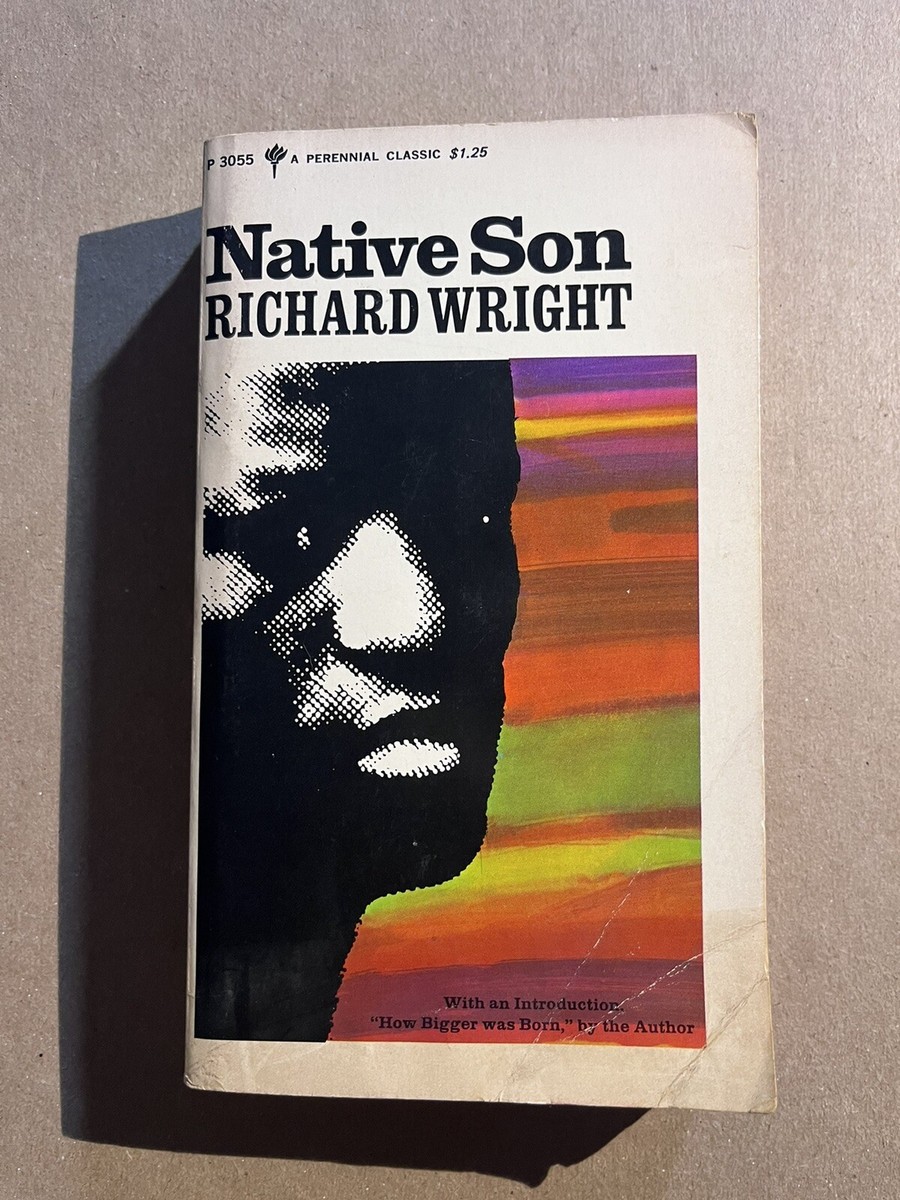
In 1933, a young Black author who had fled the South named Richard Wright had met writer Nelson Algren in the Chicago John Reed Club, a cultural organization, a part of the united front of the Communist Party of the U.S.A. Algren had an idea for his novel about living in Texas during the great depression, hoping to name it Native Son. He ended up ceding the name to Wright, who’d end up publishing the book under the name in 1940.
When he was not writing articles for the communist publication The Daily Worker, Richard Wright took time to create Native Son. Set in the 1930s, the main character Bigger Thomas is a young Black man living in a poor neighborhood in Chicago. Throughout the novel, Bigger struggles with the reality of national oppression. At one point he expresses his frustration that the white ruling class “don’t let us do nothing” and says he reckons Black folks are the “only things in this city that can’t go where we want to go and do what we want to do” (Wright 2005). Bigger’s reference to Black folks as “things” is indicative of the thematic lack of identity we continue to see. He reduces his people to mere objects that are passive, completely subject to the whims of the white ruling class.
The only time we see Bigger break free from the inanimate existence he describes is when he “felt things hard enough to kill for” things (Ibid). When describing the real-life inspirations he had for the character of Bigger, Richard Wright describes the type of person as someone who “knew that some day he’d have to pay for his freedom” (Ibid). The acts Bigger takes to break free from his social reality are oftentimes heated by blind rage to the immediate oppression he faced, hoping to rob his landlord, or kill a white woman in fear of getting caught with her. It was in “”actions such as these he felt that there was a way to escape”” from the reality of Blackness. Bigger is by no means a hero, and his violence is ill-aimed, patriarchal, and by no means liberating. The communist lawyer of the novel who defends Bigger in his trial makes the argument that he is a product of the particular social relations that denied him his personhood.
In his writings on Frantz Fanon’s Wretched of the Earth, James Yaki Sayles points out how Fanon distinguishes between the Native and Ex-Native, with a “mental pathology which is the direct product of oppression” separating the two. (Fanon 2004) Tangled up in this mental pathology, we must learn from the incorrect response Bigger represents to the national oppression that denies us our personhood. Bigger’s violence is not building an “identity apart from that of the colonizer” or a part of a struggle to “become a new person and to build a new society” (Sayles 2010). We must find our identity in a struggle to build. anew society through socialist revolution led by the multinational working class, not in mimicry like Bigger. It is correct to identify violence as a purifying force by which we will find ourselves, something which Wright’s novel offers us an inkling of. However, it is only violence employed in an organized way in the process of becoming and building that Sayles describes, not the sporadic violence Bigger employs. We must struggle to mold ourselves to build “the new earth” that
Black Communist poet Margaret Walker wrote of, as opposed to a “people blundering and groping and floundering”.
Our identity shall be found through our struggle. The premature stage of the subjective forces of the Black liberation movement correspond to the weak understanding of our national identity we see now. Today, we see how this plays out with the Trump administration’s attack on the education system. To merely acknowledge the legacy of slavery in curriculums is now grounds for the revocation of funding. Without a strong National movement to defend ourselves from these attacks, how will we even get close to answering questions pertaining to our struggle? What purpose will our narrative be if the capitalist education system ends up teaching our children the complete opposite?
When Baldwin says that “A people deprived of political sovereignty finds it very nearly impossible to recreate, for itself, the image of its past”, we must take this as a call to action (Baldwin 1961). The struggle for recreation is only possible through the struggle for political sovereignty. It is only by the shovels of our revolution will be unearth the truth of our past, and with its hammers will we will forge it into our future. Baldwin also remarked that in American society “the individual must fight for his identity”, we must modify this today to say that the Black working class and its allies must fight for our identity through socialist revolution (Ibid).
To the unnamed character of Ralph Ellison’s novel, your question still remains unanswered. We are a people who have yet to find out who we are. This is by no means an indication of despair or dread. Only by acknowledging our shortcomings and the concrete limitations of our national struggle can we overcome
them.”
Works Cited
Baldwin, J. (1961). Nobody knows my name: More notes of a native son. New York: Dell.
Ellison, R. (1995). Invisible Man. New York: Vintage Books.
Fanon, F. (2004). The Wretched of The Earth: Frantz Fanon. New York: Grove Press.
Haley, A. (1977). Roots: Alex Haley. G.B: Picador.Wright, Richard. Native Son. New York: Harper Perennial, 2005.
Hughes, L. (1947). My Adventures as a Social Poet. Phylon (1940-1956), 8(3), 205–212. https://doi.org/10.2307/272335
Sayles, J. Y. (2010). Meditations on Frantz Fanon s Wretched of The Earth: New Afrikan Revolutionary Writings. Chicago, IL: Spear & Shield Publications : Kersplebedeb Pub.
Wright, Richard. Native Son. New York: Harper
Perennial, 2005.”
 Crusader News
Leave a comment