
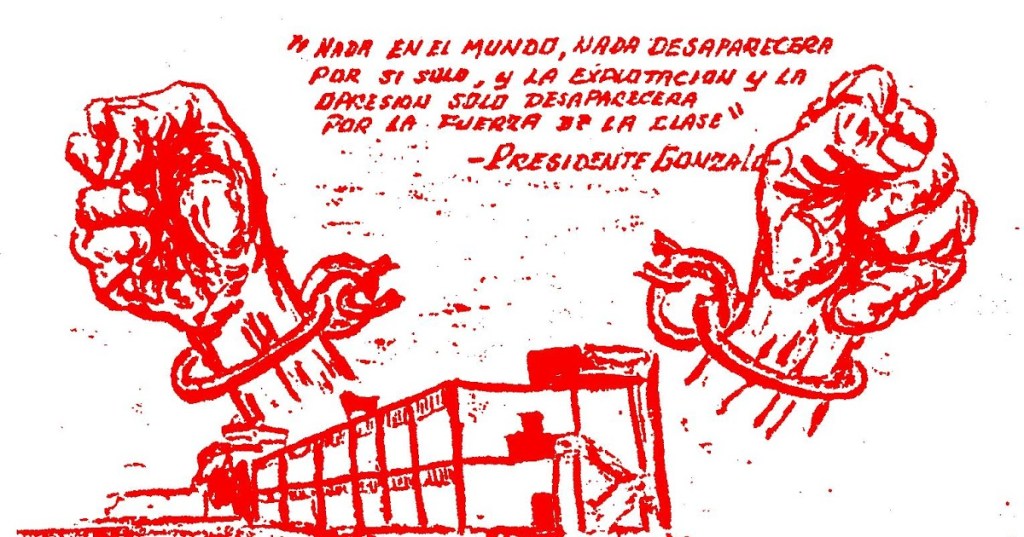


We republish this article from the Partisan, a revolutionary news service, in commemoration of the Day of Heroism. You can read more articles from the Partisan Here.
On June 19, 1986, prisoners of war and political prisoners in the El Fronton, Lurigancho and Callao prisons in Peru waged a fierce resistance against the attempted extermination and genocide by the reactionary Peruvian State. For two days the prisoners used nothing but bare hands, wooden sticks, and a handful of guns taken from the prison guards, fighting and resisting the genocidal army and marines invading from all directions armed with powerful weapons, helicopters, and armored cars. The number of deaths, including both those killed in the fight and those summarily and extrajudicially executed afterwards, is well above 300 people. This day was later named as the Day of Heroism in their honor. For the Peruvian people, it was seen not as a defeat but a great moral and political victory in the People’s War led by the Communist Party of Peru, demonstrating the immense bravery and heroism of those who gave their lives for the cause of freedom and happiness of the working people.
Who were these prisoners? Simply put, they were ordinary people from all walks of life. Some, like Gustavo Escobedo Tambo and Alberto Guerrero Hurtado, were working class organizers who were detained for agitating fellow workers against exploitation, hunger, and the bourgeois elections. Antonio Diaz Martinez was an acclaimed anthropologist who studied the poverty in the Peruvian countryside for decades. Jose Valdivia Dominguez was a famed peasant poet who was known for his sharp lyrics exposing landlords and bosses. There were also captured commanders and fighters of the People’s Guerrilla Army. All these prisoners shared the same crime, of fighting against the three mountains weighing on the backs of the Peruvian people of imperialism, semi-feudalism, and bureaucrat-capitalism, and for a better world without exploitation and oppression.
For years, the Peruvian prisoners of war and political prisoners transformed the dark prisons of the reactionaries into shining trenches of combat, effectively organizing study groups, exercises, theaters, and other activities under the tight grasp of the class enemy. Despite their physical isolation from the day-to-day struggles of the masses, these revolutionaries waged constant struggles against mistreatment and abuse by the prison authorities through iron discipline and their strong collective spirit. A bourgeois journalist, Gustavo Gorriti, who visited the prison of El Fronton in 1982, described it as almost “liberated territory,” as the prisoners were able to gradually take control of the prison and their daily routine.
The indomitable spirit and revolutionary activities made these prisoners a thorn in the side of the reactionary State. In June 1986, the prisoners of Lurigancho, El Fronton, and Callao learned about the impeding plans by the Old Peruvian State to massacre them. Instead of waiting to be slaughtered, they rose up and took over the prisons and defended their own lives with their collective power until the very last breath.
It is with the same heroism and steadfastness that Chairman Gonzalo, leader of the Peruvian revolution, resisted 29 years of solitary confinement after being captured by the Old State, until he gave his life on September 11, 2021.
In the United States, we are not unfamiliar with similar feats of resistance and heroism inside the prisons here. Revolutionaries and progressives who fight for liberation were often given life (or otherwise lengthy) sentences. Today, many former members of the Black Panther Party and fighters of the Black Liberation Army are still imprisoned for their revolutionary activities in the 1970s and 1980s, such as the cases of Comrades Mumia Abu Jamal and Kamau Sadiki. Many more, like Comrade Albert “Nuh” Washington, have passed away prematurely in prisons due to the isolation, exploitation, and abuse suffered at the hands of the class enemy. Like the Peruvian prison system, the US prison system clearly demonstrates the true nature of the State as the violent apparatus of the capitalist class to enforce its dictatorship on the multinational working class. In fact, it is commonly known to be only place where slavery is still legal.
Just like their Peruvian counterparts, prisoners in the United States have never yielded to the brutal repression of the class enemy. Imprisoned revolutionaries like Mumia Abu Jamal, Kamau Sadiki, and Kevin “Rashid” Johnson continued to contribute to the revolutionary movement through writing and wage struggles against the prison system in various forms including hunger strikes. There have been those who rose up in fierce and heroic resistance defying the Old State, such as George Jackson, who fought for his freedom with guns in hand until the last minute on August 21, 1971. These examples are likewise not far away from us: just a few days ago, on June 12, immigrants detained by ICE in Delaney Hall detention center staged a heroic uprising in the face of extreme living conditions and lack of basic sustenance, which led to the escape of 4 immigrants from State custody.
Today, the Day of Heroism is celebrated across Latin America and in other parts of the world, and it is becoming more and more well known in the United States. It is a day of remembrance, solidarity, and empowerment. The true meaning of the Day of Heroism is to celebrate those who fight for freedom as well as those who fight against the loss of their own freedom, and it serves as a torch that inspires more people to continue in their footsteps until the final victory. It is the duty for the new generation of revolutionaries-in-formation to build up a class-conscious and militant mass movement able to confront the class enemy, defend the multinational working class, and bring freedom and justice to all political prisoners and victims of US imperialism. It is as George Jackson once said, quoting the Vietnamese revolutionary leader Ho Chi Minh: “when the prison doors are open, the dragons will fly out.”
 Crusader News
Leave a comment