
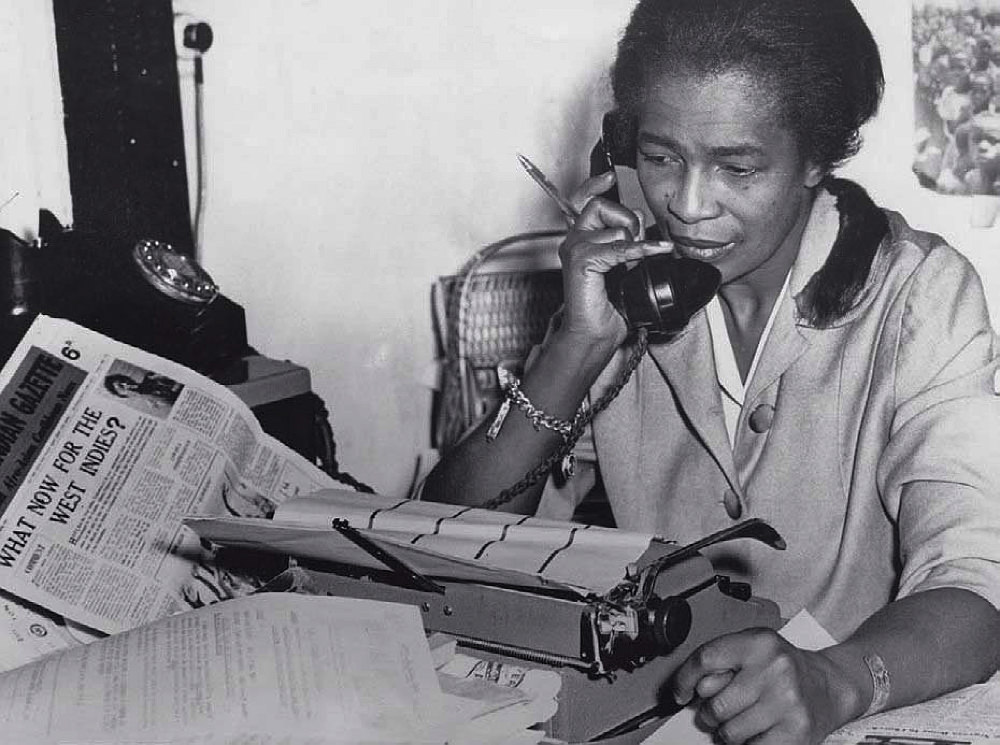


by Claudia Jones (1946)
THE POLITICAL ATTACKS that are being directed against the Negro people by Big Business have once again placed serious questions before the American working class.
These attacks, reminiscent of post World War I, are all the more serious because today the main danger of fascism to the world comes from the most colossal imperialist forces which are concentrated within the United States. The perpetrators of these attacks are the representatives of the most reactionary section of monopoly capital and of the semi-feudal economy of the Black Belt. This hook-up, expressed in Congress by the reactionary Republicans and the poll-taxers who draw their power from the oppression of the Negro people and the working class, makes it obvious that the two main forces for democracy are the working class allied with the Negro people.
In the short period since the war for national liberation, our nation has witnessed a revival of lynchings —three known lynchings in the space of three months. This blot of shame lies in America, while we proclaim to the world our “championship” of democracy for other nations!
The two-pronged drive of Big Business to decimate the war-time gains of the Negroes in industry and at the same time to destroy the alliance between labor and the Negro people, the fascist-inspired “race strikes” of American students, the recent attacks on Negro veterans in the South, and the closing of F.E.P.C.1 offices in city after city— all this necessitates the greatest political initiative and action by the trade unions and by our Party.
Coupled with this reactionary drive on the economic and political fronts, are the growing Hitler-like incitements of the Bilbos and Rankins. While popular indignation has been aroused by these events, it is obvious that labor must move more aggressively than it has so far on the vital issues affecting the Negro people.
If the alliance, crucial to progress, between the Negro people and labor is to be reinforced and extended, it is necessary to clarify the relationship between the struggle for national liberation of the Negro people and that of the working class against capitalist exploitation and oppression.
In opening this discussion, it must be made clear that the conclusions here arrived at should in no sense be regarded as a condition for the united struggle of the Negro people and the working class for Negro rights. What differences in outlook may be present as regards the thesis here presented must in no way hinder unity of all progressives in the struggle for the immediate needs of the Negro people.
The basis for this discussion article is the Political Resolution of our National Convention in July, which rejected Browder2’s revisionist position on the national character of the Negro question. A further basis is the preliminary exchange of opinion registered recently at an enlarged meeting of the newly-established National Negro Commission of our Party. At that meeting it must be stated, the views expressed revealed varying opinions on our fundamental theoretical approach to the political essence and ultimate aim of the Negro liberation movement in the United States. Similar differences of opinion are indicated in communications, club resolutions, and articles submitted to the National Office which discuss the issue of the right of self-determination for the Negro people in the Black Belt.
It is clear that a deep-going discussion of the subject is necessary. While this article will attempt to discuss some of these views, it is to be hoped that it will be followed by further discussion. The views presented here are my own.
The National Character of the Struggle for Negro Rights
Even the worst enemies of the Communist Party cannot fail to admit that we have been in the forefront of the struggle for equality of the Negro people. It was the Communist Party which fourteen years ago made the name of Scottsboro ring the world around. It was the Communist Party which was the first, since the overthrow of the Reconstruction governments, to raise in the heart of the South the issue of full Negro freedom.
What galvanized our Party to become the initiator and vanguard of these struggles? It was our understanding of the Negro question in the United States as a special question, as an issue whose solution requires special demands, in addition to the general demands of the American working class.
It was essentially this understanding that found Communists in the forefront of the struggle to combat the imperialist ideology of “white supremacy” which is today endangering the unity of the labor-democratic coalition and of the working class itself. It was essentially this knowledge that taught white American workers to fight for Negro rights in their own self-interest, to understand that to fight against white chauvinism is to fight against imperialist ideologies and practices of America’s ruling class which serves to separate Negro and white workers. It was this understanding that taught Negro workers to fight against petty-bourgeois nationalism —a result of white chauvinist ideology—and to have both Negro and white workers form strong bonds of unity with each other.
It was our understanding of the Negro question as a national question, that is, as the question of a nation oppressed by American imperialism, in the ultimate sense as India is oppressed by British imperialism and Indonesia by Dutch imperialism. It was our knowledge, grounded in Lenin’s teachings, that every aspect of Negro oppression in our country stems from the existence of an oppressed nation, in the heart of the South, the Black Belt.
We knew that the semi-slavery of the Southern sharecroppers; the inferior status of the Negro people in industry, North and South; the existence of Jim Crow in the armed forces; the Jim Crow practices of New York and Chicago, as well as of Birmingham and Tampa; the shooting two months ago of a Harlem child by a trigger-happy cop—all can be traced back step by step to the continued existence of an oppressed Negro nation within our borders.
Wherein do the Negro people in the Black Belt constitute an oppressed nation? To answer this question, we must first determine the characteristics of a nation. Marxist-Leninists hold that “a nation is a historically evolved, stable community of language, territory, economic life and psychological make-up manifested in a community of culture.”3
The Black Belt, an area in which the Negro people form a majority, came into existence with the growth of cotton culture and plantation economy. As the area of cotton cultivation moved over Westward in the days before the Civil War, so did the area of the plantation that consisted of a white-master family with its slaves.
The Civil War, which abolished chattel slavery, failed either to break up this area of Negro majority or fully to liberate the Negro people within it. Retaining their plantation lands, the ex-slaveholders soon forced the return to these lands of their former slaves as sharecroppers. A series of laws passed by Southern states—the crop-lien laws, the jumping contract laws, and so on—prevented and still prevent the free migration of the Negro people. Scarcely less than before the Civil War, is the Black Belt a prison-house of the Negroes; the chains which hold them now are the invisible chains of poverty, the legal chains of debt-slavery, and, when the landlords deem it necessary, the iron shackles of the chain gang.
The Civil War might have broken the bars of the Black Belt; it did not, for the Northern capitalists, who had gained a united market and field of exploitation throughout the nation as a result of the Civil War, were terrified by the simultaneous rise of Southern democracy, the Northern labor movement, and radical agrarian organizations. They betrayed the Negro people and the Southern white masses, and turned the South back to semi-slavery.
The migrations of the 1870’s, of the First World War, and of the Second World War, did not appreciably diminish the proportion by which the Negroes find themselves a majority today in the Black Belt—these are virtually the same. It cannot be said that this majority is accidental, or that the Negro people continue as an oppressed people within the Black Belt by inertia or by choice. They continue so because the sheriff’s posse of the twentieth century is carrying on, under new forms, the work of the slave-catchers of the nineteenth. The majority remains a majority by force.
This community in which the Negro people are a majority is neither racial nor tribal; it is composed of a significant minority of whites as well. The territory stretches contiguously westward from the Eastern shore of Maryland, and lies within Maryland, Virginia, North Carolina, South Carolina, Georgia, Florida, Alabama, Mississippi, Louisiana, Tennessee, Arkansas, and Texas.
Following the Civil War, boundary lines were definitely shaped by the defeated slaveholders to prohibit the full participation of the Negroes and poor whites in political life. If it is true in the North, where certain election districts are “gerrymandered” to prohibit the full expression of the Negro vote (and of the white vote as well), it was no less true of the Black Belt, where the majority of the inhabitants were Negroes and represented its basic core.
As to the other characteristics of nationhood: Have the Negro people, for example, a common language? They have a common language—English. If it be argued that this is the language of the entire country, we say that this is true. A common language is necessary to nationhood; a different language is not. When the American colonies separated from Britain, they had a common language, which was the same as that of their oppressors. Surely no one will argue that our community of language with our British oppressors should have kept us indefinitely in the status of a colonial people.
Is there an American Negro culture? The peculiar oppression of the Negro people and their striving for freedom have been expressed in a native way, in spirituals, worksongs, literature, art, the dance. This does not mean that American Negro culture is not part of American culture generally. Negro culture is part of the general stream of American culture, but it is a distinct current in that stream; it arose out of the special historical development and unique status of the Negro people; no other people in America could have developed this particular culture.
Have the Negro people a stable community of economic life? First, let us discuss what is meant by a common economic life. It is sometimes said that people have a common economic life when they make their living in the same way—they are all sharecroppers, or they are all workers. Actually, a common economic life with reference to a nation or community under capitalism means that the nation or community has within it the class and social relations that characterize society; it has capitalists, workers, farmers, and intellectuals, ranged according to their position in the production relations. In this case it means that a Negro must be able to hire a Negro, buy from a Negro, sell to a Negro, service a Negro.
Such class stratification exists among the Negro people in the Black Belt. There is a Negro bourgeoisie. It is not an industrial bourgeoisie. It is not a big bourgeoisie; the bourgeoisie of an oppressed nation never is; it is one of the results of national oppression that the bourgeoisie of the oppressed nations is retarded by the oppressors. The market of the Negro bourgeoisie is founded upon Jim-Crowism; it functions chiefly in life insurance, banking, and real estate. Its leadership among the Negro people is reflected in an ideology—petty-bourgeois nationalism, whose main purpose is to mobilize the Negro masses under its own influence.
By these distinguishing features, therefore, the Negro people in the Black Belt constitute a nation. They are a historically developed community of people, with a common language, a common territory, and a common economic life, all of which are manifest in a common culture.
As far back as 1913, Lenin emphasized that the Negro people constitute an oppressed nation. In an unfinished essay on the national and colonial question he made a direct reference to the Negro people as an oppressed nation, stating:
In the United States 11.1 per cent of the population consists of Negroes (and also mulattoes and Indians) who must be considered an oppressed nation, inasmuch as the equality, won in the Civil War of 1861-65 and guaranteed by the constitution of the Republic, has in reality been more and more restricted in many respects in the main centers of the Negro population (in the South) with the transition from the progressive, pre-monopolistic capitalism of 1860-1870 to the reactionary monopolistic capitalism (imperialism) of the latest epoch. (V. I. Lenin, Miscellany, Collected Works, Vol. XXX, Russian Edition.)
Browder’s Revision of Leninist Teachings
In discussing the right of self-determination for Negroes in the Black Belt, we surely cannot ignore the revisionist position taken by Earl Browder, as set forth in his article in The Communist for January, 1944, which was presented as a declaration of policy for American Communists. There Browder wrote:
… It was in view of the gathering world crisis that we Communists at that time—in the early 30’s raised the issue of self-determination. At that time, we necessarily faced the possibility that the Negro people, disappointed in their aspirations for full integration into the American nation, might find their only alternative in separation and in the establishment of their own state in the Black Belt, in the territory in which they are a majority. We raised this as one of the rights of the Negro people, in case the Negro people found this was the only way to satisfy their aspirations.
Browder further wrote:
The crisis of history has taken a turn of such character that the Negro people in the United States have found it possible to make their decision once and for all. Their decision is for their complete integration into the American nation as a whole and not for separation.
Browder thus denied that the right of self-determination for Negroes in the Black Belt was any longer an issue, since, according to him, the Negro people had already made their historic choice!
What was the fallacy on which Browder’s premise was based?
Browder’s fallacy was inherently connected with a false estimate of the relationship of forces in our nation and the world. Clearly, if a rosy future was to be envisioned in which a “peaceful” capitalism would voluntarily relinquish its exploitations, solve its contradictions, etc., the Leninist program which showed that the very essence of imperialism was the distinction and conflict between oppressed and oppressing nations no longer applied to our country!
Moreover, Browder based his premise, not on evaluating the right of self-determination as it applies to the Negro people in the Black Belt, but on one of its aspects, separation. That he saw fit to discuss the whole question from the standpoint of a “practical political matter,” confirms this. His treatment of these two demands as being identical needs examination.
Is separation identical with self-determination? The right to separation is inherent in the right to self-determination, whether that right is eventually exercised or not. It becomes a practical political matter only when the concrete objective conditions for that choice are at hand. Therefore, to identify self-determination with separation, or to substitute one for the other, is tantamount to forcing on the Negro people a choice, which they are clearly not in an objective position to make—which, in other words, though a right, is not necessarily a function of their exercise of self-determination!
It is obvious from this that the right of self-determination is not something one can dangle, withdraw, or put forward again as a sheerly objective factor. Either the objective historic conditions of nationhood exist, in which such a right remains inviolate, or they do not. Either the objective conditions exist for the choice to be made by the oppressed nation (either for separation, autonomy, amalgamation, etc.), or they do not. Thus, and only thus, can we approach the issue as a practical political matter.
How then, does the question of integration apply? Are the Negro people demanding integration in American political life? Most certainly they are! But this is no new phenomenon insofar as the Negro people are concerned. Negro Americans have been fighting for integration for over two hundred years. Every partial fight—whether expressed in the demands of the Reconstruction leaders, together with the white workers and farmers in the South for land, or in the presentday demands of Negroes in Atlanta to enforce the Supreme Court ruling against the “white primary” laws; whether it be the fight against lynching and poll-tax disfranchisement, or the recent successful campaign, conducted in Negro-white unity to re-elect Benjamin J. Davis, Jr., to the New York City Council—is a step towards integration.
But integration cannot be considered a substitute for the right of self-determination. National liberation is not synonymous with integration, neither are the two concepts mutually exclusive.
What does integration really mean? Integration, that is, democratic integration, means breaking down the fetters which prohibit the full economic, political and social participation of Negroes in all phases of American life. This does not mean that a merger, or an assimilative process necessarily takes place. In a general sense, the struggle for integration waged today by the Negro people is directed toward achieving equal rights—economic, political and social.
But the basic difference, in fact the touchstone of programmatic difference, between the liberals (as well as the Social-Democrats) and the Communists hinges on the application of the program of equal rights to the Black Belt, and, therefore, to the source of Negro oppression throughout the country—a difference based on diametrically opposed concepts of the nature of the question.
In the North, the struggle for equal rights for the Negro people is chiefly that of heightening the fight to secure equal participation in every sphere of American life. The problems of the Negro people in the North are akin to those of an oppressed national minority. Particularly here, the fight for equal rights as a whole is enhanced by the presence of a large and growing Negro proletariat, in the area of the most highly developed capitalism, as well as by the participation of the advanced workers throughout the country for equal rights for Negroes. In fact, it is the existence of a strong Negro proletariat—represented today by close to one million organized trade unionists—that provides the intimate link between the American working class as a whole and the struggle for emancipation and land for the oppressed Negro people and white workers in the Black Belt.
In the Black Belt the problem is chiefly that of wiping out the economic, political, and social survivals of slavery, of the enforcement of equal rights. Without the necessary enforcement of equal rights for the Negro people in the Black Belt, including social equality, it is folly to speak of integration as being equal to the achievement of national liberation. Hence, equal rights for the Negro people in the Black Belt can be achieved only through enforcement, through their exercise of the right of self-determination.
The right of self-determination does not exclude the struggle for partial demands; it pre-supposes an energetic struggle for concrete partial demands, linked up with the daily needs and problems of the wide masses of the Negro people and the white workers in the Black Belt. The fight for such partial demands, moreover, is a struggle for democracy. It does not divert or overshadow the working-class struggle against exploitation, it is an aid to it.
It is only by helping to interconnect the partial demands with the right of self-determination that we Communists, in concert with other progressive forces, can contribute guidance to the struggle for complete equality for the Negro people.
Certain Contentions Examined
We Communists adhere to the fundamental belief that complete and lasting equality of imperialist oppressed nations and peoples can be guaranteed only with the establishment of Socialism. The aim of Socialism is not only to abolish the present division of mankind into small states, not only to bring nations closer to each other, but ultimately to merge them. But we have never ignored the historical process necessary to the achievement of that goal. Nor can we “postpone” the question of national liberation until Socialism is established or speak solely in general nebulous phrases about national liberation. We must have a clear and precisely formulated political program to guide our work in the achievement of that goal. For we know that “mankind can achieve the inevitable merging of nations, only by passing through the transition period of complete liberation of all the oppressed nations, i.e., their freedom to secede.” (Lenin, Selected Works, Vol. V. International Publishers, p. 271.)
As Leninists, we are distinguished from the reactionary Social-Democrats in that we reject, even if it is under the name of “internationalism,” any denial of the right of national self-determination to the oppressed peoples. For true internationalism, that is, Marxism-Leninism, places the right of self-determination as a basic programmatic point. The “internationalism” of the reformists is nothing more or less than the nationalism of their own respective imperialist rulers, while the national program of Lenin is an essential part of internationalism. Any “internationalism” that denies the right of self-determination to the subject peoples is false, is a mere cover for imperialist chauvinism.
Our approach is based on proletarian internationalism, which recognizes that the workers of an oppressing nation best fight against national oppression — especially by their “own” bourgeoisie—once they understand that such is the road to realize their own freedom. It is based on the Marxist proposition that “no nation can be free if it oppresses other nations.”
Clearly then, those who impute to the Negro people the main responsibility for “accepting” or “rejecting” the principle of self-determination ignore this tenet: they base their conclusions on the subjective factor, instead of the objective and historical conditions of oppression of the Negro people in the Black Belt.
But let us examine some of these arguments. Is it true that the Negro people do not want self-determination, that the Negro people shy away from this concept with abhorrence? Definitely not! It is, of course, quite a different matter if we speak of the Negro people as not being fully concious of this concept in our terms. But to challenge the deepest desires of the Negro people for freedom and equality as being other than that of the fullest national self-affirmation is to fail to understand their fundamental aspirations!
What do the Negro people abhor? They abhor the continuation of their actual status in the Black Belt— that of forcible segregation. They abhor Jim Crow from which they suffer in many forms today. They abhor the freedom with which the poll-taxers and feudal landowners, by dividing Negro and white, continue their oppression of the Negro people. They abhor the ideology of “white supremacy”, which flouts the basic tenets of our Constitution, as the counterpart of Hitler’s “aryan supremacy.” They abhor any idea which holds out the perspective, not of full freedom and equality, but of something less than these things. And the slogan of self-determination expresses precisely these aspirations in the most complete sense.
To argue that the Negro people “don’t want self-determination,” is unwittingly to give sanction to the poll-taxers and feudal landowners in the South to continue exploiting the Negro people and poor whites on the basis that “this is what the Negroes want”; it is to argue against a conscious fight by white American workers to help achieve the objective conditions in which the Negro people can freely make their own choice. It is to blunt the struggle for national liberation, to have at best, a bourgeois-liberal approach.
Is it any wonder, then, that the most vehement voices against this principle, are not the mass of the Negro people, but the enemies of the white workers and the Negro people? The Social-Democrats (and the reactionary mouthpieces of monopoly capital and semi-feudal economy), who advance the ridiculous charge that self-determination would “Jim Crow the Negro people,” “Create a Black Ghetto,” and other such arguments ad nauseam, are exposed in their full light when we examine their real motives. They seek to cover up their denial of the double oppression of the Negro people—as wage slaves and as Negroes. They seek to obscure the fundamental character of the status of the Negro people in the Black Belt—which is essentially national and rooted in economic and historic conditions of a pre-capitalist nature. Nor can all the piety and wit of Social-Democracy cancel out its real aim—which is to serve imperialism and therefore betray the Negro people and the working class.
Another view holds that the industrialization of the South and new migrations has fundamentally altered the relationship of the Negro people to the land. The proponents of this view maintain that such a development has radically changed the character of the Negro question in the Black Belt from that of oppressed nationhood, if such it was in the past, to that of a class question.
In discussing such views, we should, at the outset, distinguish between the effects of industrialization in the South as a whole and in the Black Belt. The continued existence of economic slave survivals in the Black Belt is a fundamental distinction that must be made in an examination of the characteristics of nationhood among the Negro people. Unless this is done, we shall not be able to understand the problems either of the South as a whole or of the Black Belt in particular.
There has unquestionably been some increase of industrial expansion in the South. The war requirements for victory necessitated the expansion of a number of basic Southern industries, such as steel, coal, textile, lumber and shipbuilding. In addition, new industries, such as aircraft and munitions, were built. Capital investments, however, came primarily from the Federal government. Over $7,000,000,000 were thus expended solely as a war necessity. It is obvious that such investment for expansion of existing plants and the building of new industries no longer exists. The reverse is true— that is, the closing down of plants and a drastic curtailment of industrial production. Thus, it is clear that no trend exists at present which would permit one to speak of the industrialization of the South. The trend that was evident during the war was a temporary phenomenon.
By 1944, Mr. D. B. Lasseter of the Atlanta, Georgia, Regional Office of the War Manpower Commission was able to warn us of this trend in summarizing what war orders meant to the South. Taking note of the more than seven billion dollars in prime contracts in six Southern states alone, Lasseter wrote in Social Forces for October, 1944:
At first glance, these factors appear as bright prospects, but there is ample cause for anxiety lest this war-inspired prosperity prove only temporary. For while industrial activity and facilities have increased tremendously, there will be great difficulty in maintaining these gains after the war. When the shooting is over the plants responsible for the current boom will shut down entirely, or production will be sharply curtailed. And a glance at the record shows that there is a heavy concentration of this type of industry and activity. The South is packed with Army camps, and shipbuilding, airplane and munitions plants further account for much of our industrial development. None of these offers a rosy future as a peacetime investment.
Lasseter added:
The South faces a grave readjustment. Having had its first taste of prosperity resulting from increased industrial activity, it is slated to lose the source of this prosperity.
It goes without saying that expansion and building of new industries in the Black Belt would, of course, have its influence among the Negro people. Such a process would lead to the extension of the working class base among the Negro people. Instead of de-limiting the national characteristics of the Negro people, it would help importantly to develop the national consciousness of the Negro people and thus accelerate the realization of the aim of self-determination. The extension of the working-class base in the oppressed Negro nation is fundamentally the guarantee of the successful forward movement of the national liberation cause of the entire Negro people.
Self-Determination—A Guiding Principle
It is my opinion that we again must raise the right of self-determination for the Negro people in the Black Belt, not as a slogan of immediate action, but essentially as a programmatic demand. It might perhaps be argued that, raised in this manner, the slogan is academic and should therefore not be raised at all. Such criticism fails to take into account the difference between a slogan advanced as an issue on the order of the day and a guiding principle.
We must place the question in terms of historical perspective, taking into account concretely the stage of the Negro liberation movement today and the present practical struggle for full Negro rights, in behalf of which there must be established both the broadest Negro unity and the broadest Negro and white alliance. Between the current struggles and the programmatic slogan here advanced there is no conflict, but a vital interconnection. The goal of national self-determination should serve as a beacon to the day-to-day struggles for Negro rights, and these struggles, in turn, should serve to hasten the realization of the right to self-determination.
1New Deal-established Fair Employment Practices Committee.
2Earl Browder, renowned internationally for his revisionist leadership of the CPUSA.
3Joseph Stalin, Marxism and the National Question, International Publishers, New York, p. 8

 Crusader News
Leave a comment